
You've seen them at weddings, on your grandmother's or mother's silk saree, maybe even folded away in your own cupboard right now - the zigzag border, the looping dot pattern, the little gold bird tucked into a corner. Most of us have looked at these a hundred times without ever knowing what they're called, or why they're there at all. So let's fix that.

The Zigzag Border You Always Assumed Was "Just Design"
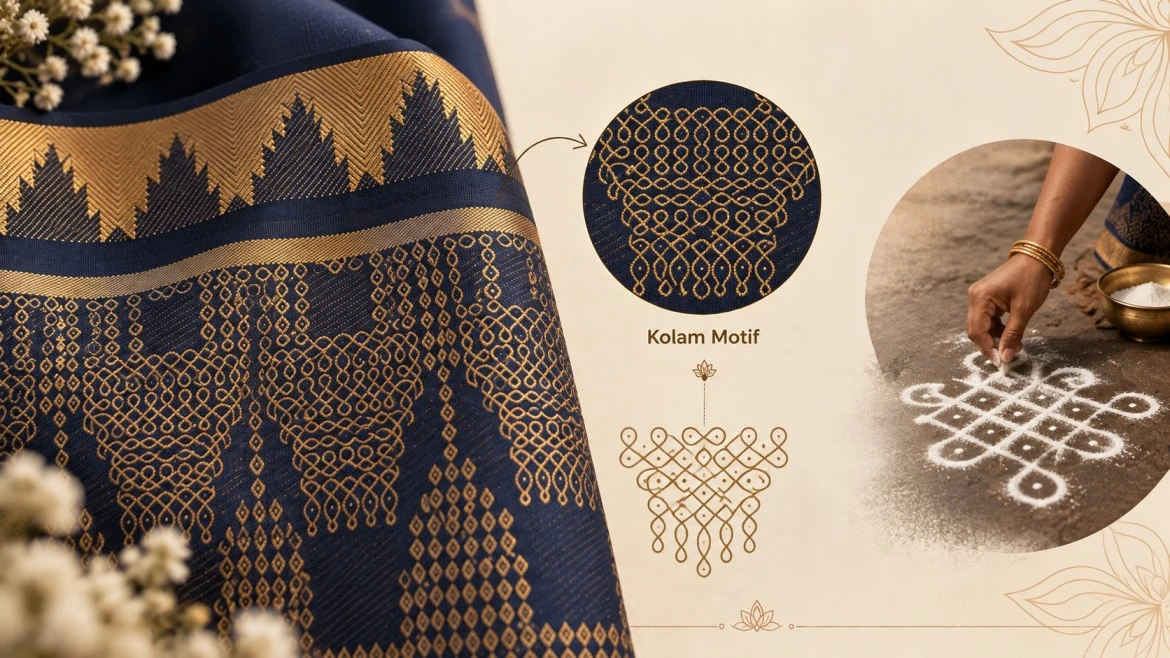
That stepped, pyramid-like pattern running along a saree's border isn't random geometry - it's a temple motif, modeled on the gopuram (the tiered entrance tower of South Indian temples).
Borders like this have been woven into silk sarees for generations, carrying a quiet nod to temple architecture into everyday fabric. It's usually the first motif your eye catches, simply because it frames the whole saree.
The Looping Pattern That's Actually Older Than the Saree Itself
Ever noticed a repeating, interlaced dot-and-line pattern running through the body of a saree? That's a kolam-inspired motif - based on the rice-flour patterns drawn by hand outside South Indian homes every single morning, as a daily ritual of welcome and auspiciousness. What starts as a fleeting floor drawing, gone by evening, gets a second life woven permanently into silk.
The Looping Pattern That's Actually Older Than the Saree Itself
Ever noticed a repeating, interlaced dot-and-line pattern running through the body of a saree? That's a kolam-inspired motif - based on the rice-flour patterns drawn by hand outside South Indian homes every single morning, as a daily ritual of welcome and auspiciousness. What starts as a fleeting floor drawing, gone by evening, gets a second life woven permanently into silk.
The Gold Bird Everyone Mistakes for a Peacock
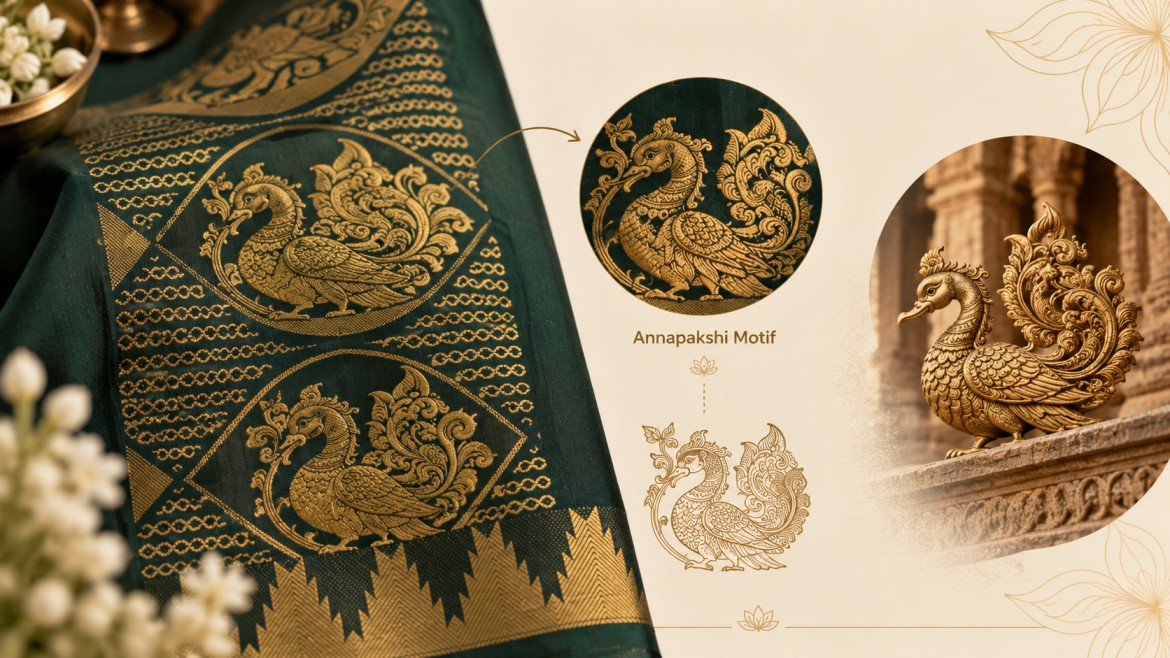
If you've spotted a stylized, swan-like bird motif on a saree's pallu or border and assumed it was a peacock, you're not alone - it's one of the most common mix-ups in saree motifs. That bird is actually the annapakshi, a mythical swan from Indian mythology, often depicted as the vahana (vehicle) of Goddess Saraswati. In Kanchipuram silk weaving especially, the annapakshi is considered one of the most auspicious motifs there is, traditionally reserved for wedding and ceremonial sarees, usually woven in gold zari for that unmistakable regal shimmer.
Why These Three Keep Showing Up Together
Temple, kolam, and annapakshi motifs share more than just a South Indian silk-weaving heritage - they're all rooted in the same idea: everyday devotion and auspiciousness, translated into something you wear. The temple border frames it, the kolam fills it, and the annapakshi crowns it, usually on the pallu, as the motif of honor.
Here's Where It Gets Interesting
Most sarees feature these as three separate design elements, each doing its own thing. On our Ellampillai silk saree, we did something different - the temple motif's shade is woven directly into the kolam pattern itself, instead of staying separate. It's a small design choice, but it's one you won't typically find on a traditional saree, and it's exactly the kind of detail that rewards someone who knows what they're looking at.
So, Next Time You Spot One
You'll know the zigzag border is a temple gopuram, the looping pattern is a kolam, and that gold bird everyone calls a peacock is actually an annapakshi, blessing the wearer with grace and auspiciousness. These patterns were never "just design" - they're centuries of meaning, quietly folded into six yards of silk. See all three motifs on the Elampillai semi-silk saree, available in 11 shades, at Aadai.